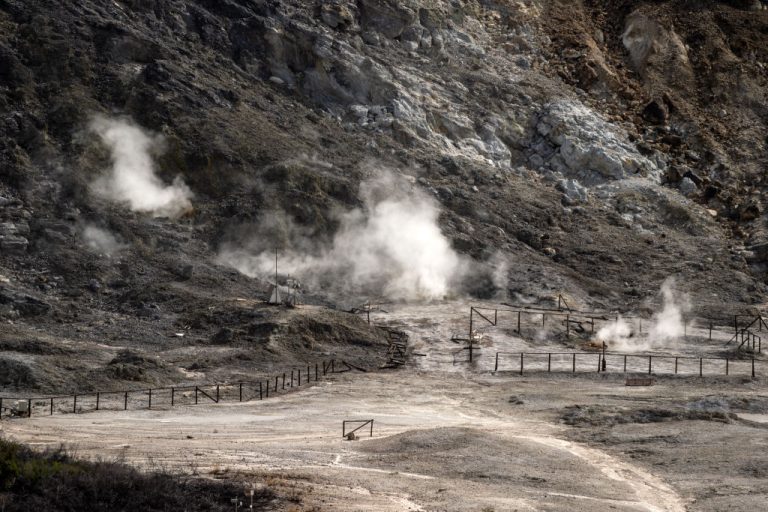
The Phlegraean Fields, located in Italy just west of Naples, are now considered a massive supervolcano and scientists have been observing increased activity in the fields since 2005, raising concerns about volcanic emissions and a potential large-scale eruption.
A supervolcano is like any other volcano except they are much, much larger, and are capable of producing eruptions thousands of times more powerful than a typical volcano.
An eruption from a supervolcano can release more than 1,000 cubic kilometers of material into the atmosphere, material that would have catastrophic effects on the Earth’s climate and environment.
One of the world’s more well known supervolcanos is located in the United States in Yellowstone National Park, called the Yellowstone Caldera. It sits over a massive magma chamber and is responsible for the park’s geothermal features like geysers and hot springs.
When supervolcanos erupt, they create craters so huge that they can span dozens of miles.
Success
You are now signed up for our newsletter
Success
Check your email to complete sign up
While such eruptions are extremely rare, scientists keep an eye on these volcanoes due to their potential to impact life across the planet.
READ MORE:
- The Great Corporate Shift: 4 Reasons Why US Companies Are Pulling Out of China
- Japanese Firms Retreat From China En Masse Amid Worsening Economic Woes
- Chinese Tech Giants Are Aggressively Recruiting American Talent out of Silicon Valley
The Solfatara crater
Scientists have been keeping an eye on the Solfatara crater, part of the Phlegraean Fields, and what it emits.
Right now, the crater emits somewhere between 4,000 and 5,000 tons of carbon dioxide on a daily basis, about the same amount of emissions that burning 500,000 gallons of gasoline would create.
In a recent paper published in Geology, Gianmarco Buono, a volcanologist with the Italian National Institute of Geophysics and Volcanology (INGV), who is leading a study to understand the emissions from the fields better, said that he and his peers estimate that between 20 and 40 percent of the carbon dioxide emitted comes from the dissolution of calcite in the surrounding rocks, with the balance coming from underground magma.
With increased activity in the fields, magma gets pushed closer to the surface of the planet where pressure decreases allowing gases previously trapped in the magma to be released.
These gases include water vapor, carbon dioxide, and sulfur dioxide.
A noticeable increase in gas emissions is a sign of potential volcanic activity. However, this would not necessarily lead to an eruption.
However, the region has erupted before.
Around 39,000 years ago, it’s believed the region erupted releasing upwards of 200 cubic kilometers of material, which had a significant impact on the climate and may have played a major role in the extinction of the Neanderthals.
A smaller eruption occurred in 1538 AD which formed what is known today as Monte Nuovo, a “new mountain” which is located near Naples in southern Italy.
READ MORE:
- Once the ‘World’s Factory,’ Closing Businesses and Decaying Industrial Parks Litter Dongguan, China
- Enough Lithium in Southern Arkansas to Meet 2030’s Global Demand: USGS
What if it erupts?
If the Phlegraean Fields were to erupt the outcome would be catastrophic.
Locally, Naples and its metropolitan area — home to over 3 million people — would face severe destruction due to pyroclastic flows, ashfall, and lahars.
A lahar is a type of destructive volcanic mudflow or debris flow.
There would be mass evacuations of millions of people in the region. Managing this kind of evacuation would be a logistical nightmare and would easily overwhelm local and international relief efforts.
Emissions of carbon dioxide and sulfur dioxide due to an eruption could asphyxiate people and animals and lead to acid rain, damaging ecosystems and agriculture.
The impacts of such an eruption would also have global implications.
First, ashfall across Europe would be significant, so much so that it could potentially bury entire regions under several meters of ash.
The release of so much ash into the atmosphere would bring about a “volcanic winter,” a phenomena that occurs when sulfur aerosols in the stratosphere reflect sunlight, leading to global cooling for months, or even years.
Such an event would undoubtedly impact crop production worldwide due to reduced sunlight reaching the Earth’s surface.
The Phlegraean Fields are a stark reminder of the volatility of Earth’s environment.
While the immediate risk of an eruption remains low, the Phlegraean Fields are considered one of the world’s most dangerous volcanic systems due to its location near a major population center and its potential for massive eruptions. Vigilant monitoring is crucial to minimize risks and protect nearby communities.